
Gaspare Gabrielli – VERKAUFT
Gaspare Gabrielli
(1770 – Rom – 1828)
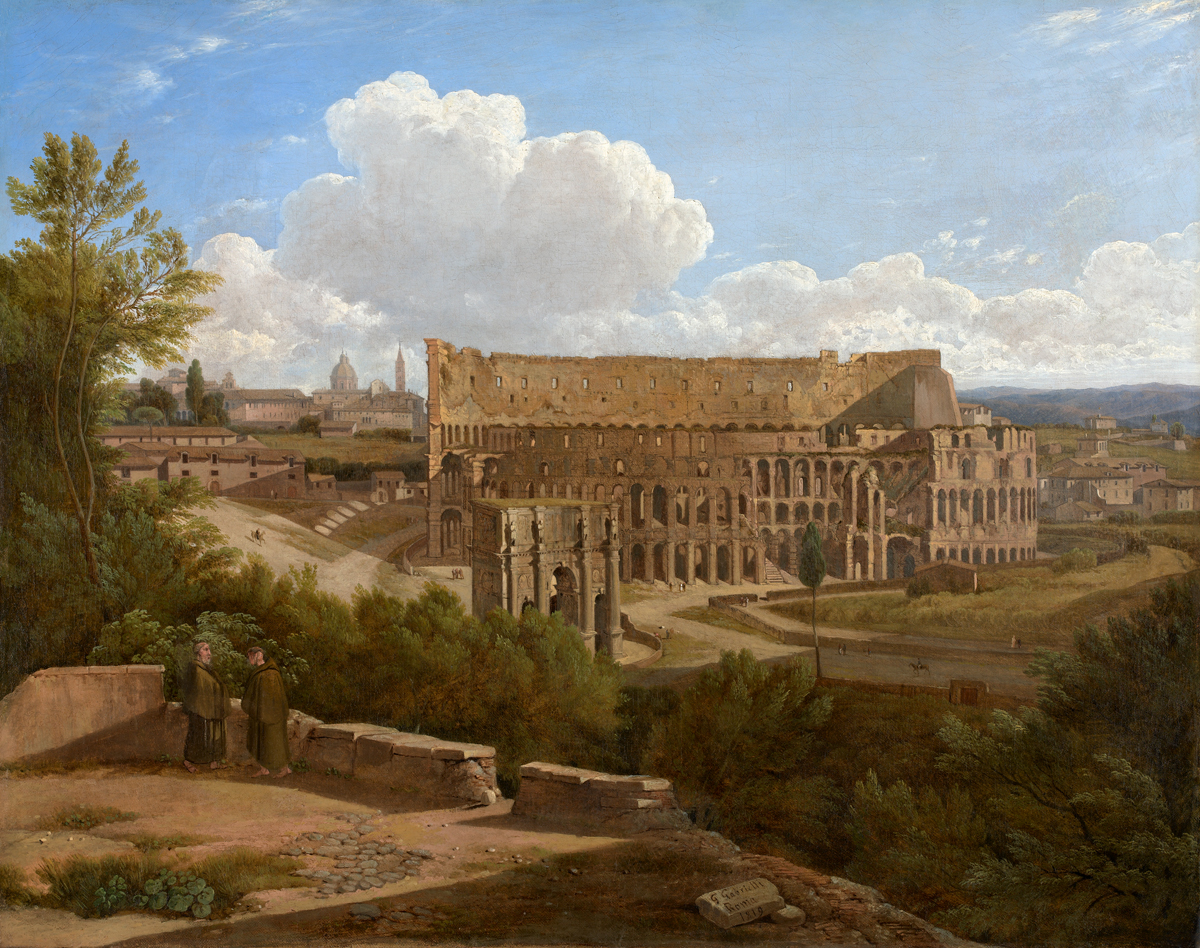
Blick vom Palatin auf den Konstantinsbogen und das Colosseum, 1819
Öl auf Leinwand, 46,4 x 59 cm
Signiert und datiert unten rechts G. Gabrielli / Roma / 1819
Provenienz:
Auktion London, 1950er Jahre
Seitdem in Familienbesitz, East Dorset
Provenance:
Private collection, Dorset (purchased in a London sale in the 1950s
In the autumn of 1805 the landscapist Gaspare Gabrielli was invited to leave Rome for Ireland by Valentine Brown Lawless, 2nd Baron Cloncurry (1773-1853). Gabrielli was commissioned to execute a fresco cycle at Lyon House, Cloncurry’s country seat in County Kildare. He was to spend the following two years at Lyon. Cloncurry, an active supporter of the Irish independence movement, was a noted connoisseur and avid art collector. He had arrived in Italy in 1803 and was very active in purchasing antiquities, paintings and artefacts for his collections.[1]
On completion of the Lyon commission, Gabrielli moved to Dublin with his wife, a maid to Lady Cloncurry. He enjoyed rapid success and forged strong contacts in Irish artistic circles. Between 1809 and 1814 he was to show over sixty works in exhibitions staged by various artists‘ societies in Ireland. He was elected president of the Society of Artists of Ireland in 1811 and regularly sent landscape paintings to London for the Royal Academy exhibitions.
Gabrielli moved back to Rome with his wife and son in 1816 and took rooms on the Via Sistina. He acquired a teaching post and became a member of the Accademia di San Luca in the following year. He nurtured the contacts he had made in Ireland and his studio developed into an attraction for Irish and English travellers on the Grand Tour. Commissions for landscapes and views of Rome flooded in. The year 1819 probably saw him at the peak of his career and the height of his artistic powers. It was also the year in which the present two paintings were executed. In JMW Turner’s List of Contemporary Landscape Artists Working in Rome 1819 Gabrielli features alongside Franz Ludwig Catel, Joseph Anton Koch and Achille Etna Michallon.[2] In 1819 he was appointed agent to William Spencer Cavendish, 6th Duke of Devonshire (1790-1858). It was Gabrielli who introduced Cavendish to Schadow, Thorvaldsen and Canova.[3] Cavendish’s stepmother, Elizabeth, Duchess of Devonshire (1759-1824), commissioned a luxury edition of Virgil’s Aeneid. The book was published in London in 1819/1821 and includes plates engraved by Wilhelm Friedrich Gmelin after landscapes by Gabrielli. One of the plates is a View of the Roman Forum showing the Palazzo Senatorio in the background.[4] A large-format version of the same subject in oil – very probably commissioned by the Duchess[5] – is today in the collection of the Duke of Devonshire at Chatsworth.
The present two paintings depicting the Roman Forum and the Colosseum have only recently come to light in an English private collection. They were almost certainly acquired in Rome by a wealthy Irish or English grand tourist as mementos of the Grand Tour. Gabrielli’s handling of the atmospheric qualities of light and his depiction of architectural detail are masterly. Both paintings have a dual function: they evidence his virtuosity as a painter and his patrons‘ desire for visual aide-memoires to keep alive their memories of Italy’s cultural heritage.
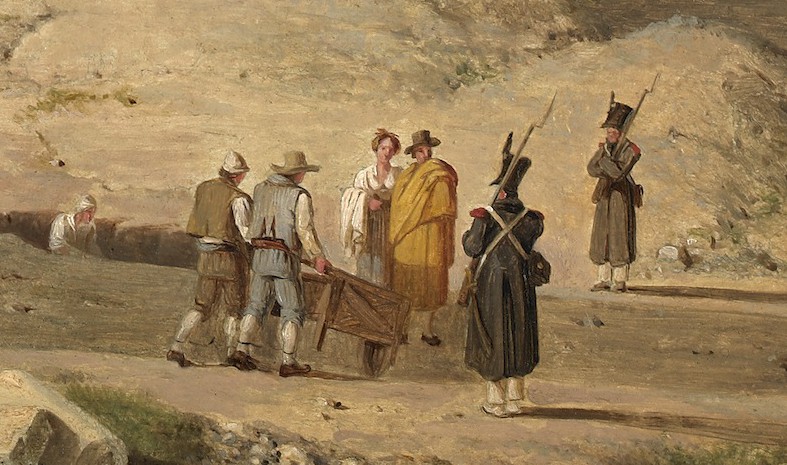
In the painting titled View of the Roman Forum and the distant Palazzo Senatorio Gabrielli has chosen a viewpoint in front of the Arch of Titus overlooking the Roman Forum towards the Capitol. In the distance the rear facade of the Palazzo Senatorio stretches across the centre of the image. The Palazzo was built in the sixteenth century on the foundations of the Tabularium, the records office of ancient Rome. The ruins of the temples of Saturn and Vespasian, the Column of Phocas and the Arch of Septimius Severus can be glimpsed on the distant slope of the Capitoline Hill. The three remaining columns of the Temple of Castor and Pollux dominate the composition at the left. Delicately fluted, they are crowned by Corinthian capitals. They were half-buried until excavation work, begun under Giuseppe Valadier in 1810, exposed them in 1813. Views of the Roman Forum before excavation, its ruins still buried under debris, had been popular in the seventeenth and eighteenth centuries. However, the appearance of the site began to change radically from 1802 onwards, when first attempts at clearance were made and systematic archaeological excavation began under Valadier and Carlo Fea. In his depiction of the Forum, Gabrielli documents the site exactly as he saw it, giving a very precise and detailed account of work in progress. Armed guards are present because the heavy labour, including the removal of excavation debris, is being carried out by convicts, their fettered legs depicted by Gabrielli in meticulous detail (Fig. 1). This unusual measure was introduced under Napoleonic rule with the aim of rapidly completing excavation work in readiness for the Holy Year of 1825.[6]
Auf der anderen Ansicht erscheinen zum Greifen nah das Kolosseum und der Bogen des Konstantin, eingebettet in das Panorama der Ewigen Stadt und der umliegenden Hügel. Zur linken Seite nimmt man den romanischen Campanile und die zwei Kuppeln von Santa Maria Maggiore wahr. Zwei Franziskanermönche aus dem nahen Kloster San Bonaventura[7] stehen, in ihr Gespräch vertieft, auf der in der Antike angelegten Terrasse an der nordöstlichen Seite des Palatin. Seit dem 17. Jahrhundert wurde dieser Ort nach der berühmten Familie die ihn besaß Vigna Barberini[8] – Weinberg der Barberini – genannt. Während der letzten 100 Jahre war die Vigna Barberini für die Öffentlichkeit nicht zugänglich. Erst seit 2009 kann man den Blick von der Terrasse auf das Kolosseum wieder genießen.
[1] Zusätzliche Berühmtheit brachte ihm ein Prozess ein, den er 1807 gegen Sir John Bennett Piers, 6th Baronet, of Tristernagh Abbey, anstrengte. Dieser hatte nach einer Wette, dessen 16jährige Frau verführt. Die Klage war erfolgreich, und er erhielt 20.000 Livres Schadenersatz – Zeuge war Gabrielli, der die Szene von einem Gerüst aus beobachtet hatte.
[2] Vgl. Nicola Moorby, ‘A List of Contemporary Landscape Artists Working in Rome 1819 by Joseph Mallord William Turner’, in David Blayney Brown (Hg.), J.M.W. Turner: Sketchbooks, Drawings and Watercolours, Dezember 2012, https://www.tate.org.uk/art/research-publications/jmw-turner/joseph-mallord-william-turner-a-list-of-contemporary-landscape-artists-working-in-rome-r1138651 (04.09.2014).
[3] Vgl. Maestà di Roma. Da Napoleone all’unità d’Italia. Universale ed Eterna Capitale delle Arti, Kat. Ausst. Rom, Scuderie del Quirinale, Galleria Nazionale d’Arte Moderna und Villa Medici, Rom 2003, S. 471.
[4] Auch der deutsche Maler Franz Ludwig Catel arbeitete im Auftrag der Herzogin an dem Projekt mit und lieferte Illustrationsvorlagen. Vgl. Andreas Stolzenburg, Der Landschafts- und Genremaler Franz Ludwig Catel (1778-1856), Kat. Ausst. Rom, Casa di Goethe 2007. S. 31-36.
[5] Ansicht des Forum Romanum, Öl auf Leinwand, 84,3 x 103,5 cm. Lady Morgan erinnert sich in ihrem Buch Italy an dieses Gemälde. Vgl. Lady Morgan, Italy, Bd. II, London 1821, S. 437. Eine weitere, ebenfalls 1819 datierte Ansicht Öl auf Leinwand, 46 x 58 cm, Privatsammlung, ist publiziert in vgl. Maestà a Roma, op. cit. S. 470, Kat. Nr. X.1.3.
[6] Vgl. Maestà a Roma, op. cit. S. 471.
[7] Zwei für den Betrachter nicht sichtbare Kirchen schließen sich der Vigna Barberini an: die kleine Kirche San Sebastiano an der Nordseite, der Legende nach der Ort des Martyriums des Heiligen Sebastians. Im Süden befindet sich die Franziskanerkirche San Bonaventura, die 1625 der Kardinal Francesco Barberini zusammen mit dem Kloster erbauen ließ
[8] Bereits im 19. Jahrhundert wurden Ausgrabungen auf der Vigna Barberini unternommen und die Thermen und der Tempel des Kaisers Elagabalo (218-222 v. Chr.) freigelegt. Vgl. Soprintendeza Speciale per i Beni Archeologici di Roma: http://archeoroma.beniculturali.it/foro-romano-palatino/vigna-barberini (04.09.2014).